
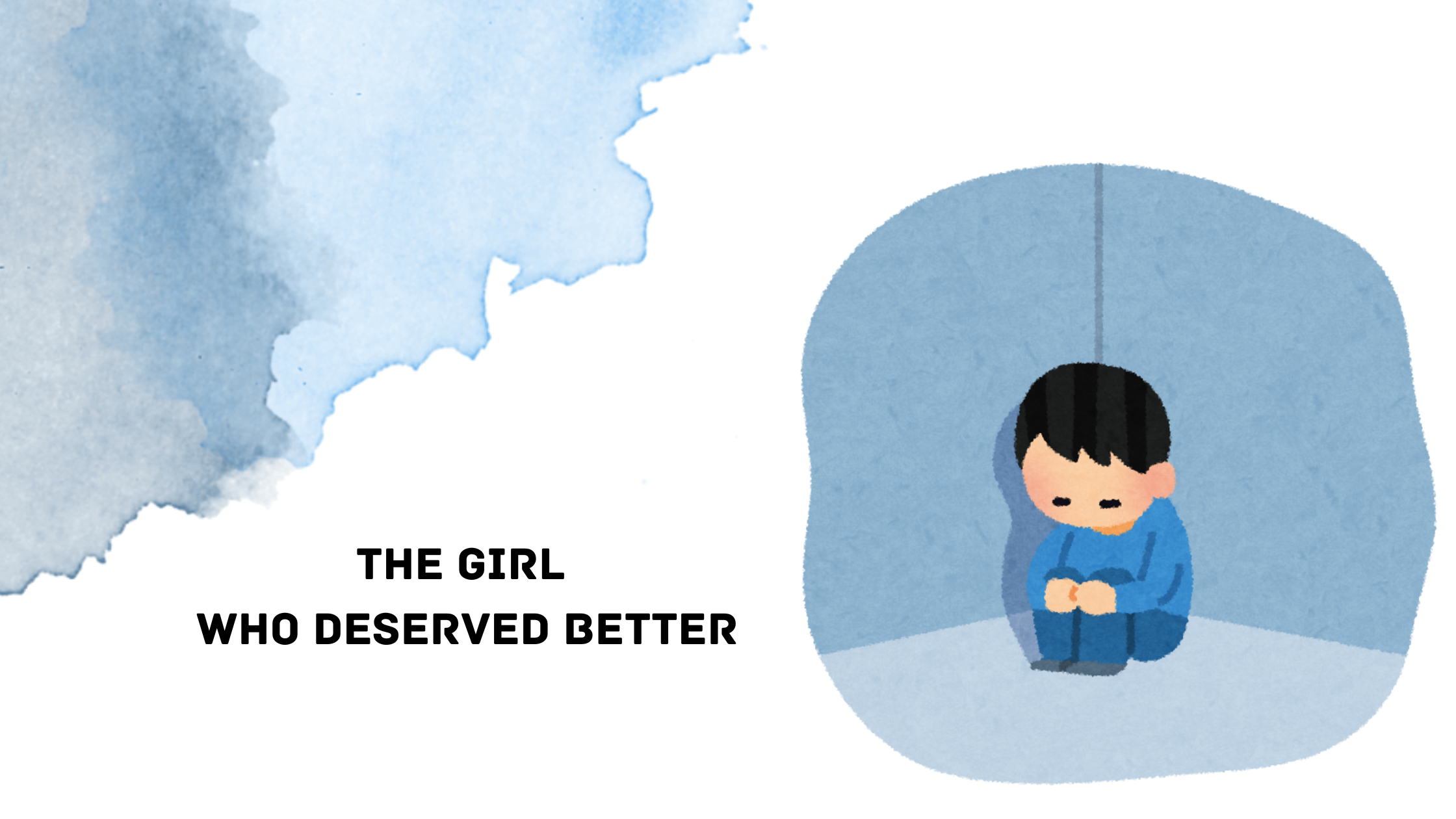
It was a rainy morning. She swiveled in bed, restless, feeling the familiar exhaustion—the kind that had less to do with sleep and more to do with what awaited her on the other side of the school gate. Rain, she decided, was reason enough to stay home . So, she waited, half-hoping.
The rain stopped minutes before she had to leave to reach the school on time. Of course it did.
She gathered her things and left, unwillingly.
Her father had come to drop her, and had left. She stood at the gate and watched his bike until it disappeared around the corner — smaller, smaller, gone. She didn’t move for a moment.
Before stepping in, she ran through the day in her mind — bracing for it. She already knew what was coming: the looks, the whispers, the gloomy atmosphere that would wrap itself around her the moment she crossed the threshold. She didn’t want to go in.
She looked at the empty road where his bike had been, and wondered — quietly— why he couldn’t save his little girl one last time.
She went in.
The moment she entered the premises, she felt it—that specific, suffocating awareness of being watched. Not admired. Watched. Eyes that carried something close to disgust. She scanned the corridor instinctively, the way one does when one knows the terrain is hostile. A female teacher stood near the far end of the hallway, and even from that distance, she could feel the judgement in her gaze—steady, cold, as if she had walked into school not as a student, but as a threat. As if her only purpose was to leave the boys astray. She mapped her route carefully, avoiding clusters of people. dodging eye contact, taking the longer path, if it meant not having to face anyone.
When she finally reached her classroom, she dropped her bag on the bench and exhaled.
Safe. For now.
She decided she wouldn’t step outside until the prayer assembly. She wouldn’t speak to anyone she didn’t have to. Every unnecessary interaction felt like a risk — a chance for the word to be applied to her again, out loud or in a glance. She had learned, without anyone teaching her, that the less she existed in that building, the less she could be punished for existing.
It all started on a day that looked like any other. A group of female teachers pulled her aside. They had been gathering things: rumours, hearsay, the loose talk of children in private tuitions. They had taken these fragments and built something out of them. A case. A consensus. A judgment.
She stood before them with her head hanging over the table. She did not cry. She did not lament. She did not know what to do, or what she was supposed to do, or what any of this was actually about. She waited for someone to name it — to tell her what exactly she had done, what rule she had broken, what line she had crossed. The words never came.
They never named the accusation.
Perhaps because they could not. Perhaps because if they had tried to say it out loud — to a fourteen-year-old girl, in a school, in the daylight — they would have had to hear it themselves. So they left it shapeless. They let it hang in the air, heavy and unspoken, and somehow that was worse. A named thing can be argued with. But what can you do with something that carries no name, and hence, has been given no actual existence? It is only applied to you, and you don’t know how to rid yourself of it.
What she understood, without being told, was that she had failed to be what they considered a good girl. She had not been given a definition of that either. But she had fallen short of it.
She left that room with her head down. She knew, with the particular certainty that only deep humiliation brings, that she could never hold it high again in front of these people. Not really. Not in the way she had before that day.
A child walked in. Something smaller, reduced walked out.
That was four years ago. She had been carrying it ever since.
She was a girl who deserved better.
Schools are not incidental spaces. They are the places we have collectively decided to entrust with the most vulnerable years of a child’s life — the years when she is still becoming, still forming, still learning what the world thinks of her and, more dangerously, what to think of herself. A school is supposed to nurture. To protect. To educate. To hold a child when she goes astray, not push her further into the dark.
Teachers carry that responsibility. Female teachers, particularly, carry something more.
They are not simply instructors of syllabus and timetable. They are, whether they choose it or not, the first adult women these girls will study closely — the first proof of what womanhood looks like inside an institution. They have the rare and consequential power to show a teenage girl that she is seen, that she is safe, that the confusion and intensity of what she is living through is not shameful but human. They can offer what so many girls are quietly desperate for: trust, compassion, gentleness, and the steady reassurance that she is not too much.
Instead, something else is happening.
Instead of guardianship, there is competition. Instead of mentorship, there is enmity. And one has to ask — with genuine bewilderment, not accusation — what is this anger for? What is it that a teenage girl possesses that provokes such disgust in the women who are paid to protect her? Is it her youth? Her freedom? The unlived choices that her very existence seems to taunt? Is it that she stands at the beginning of a life that her teachers feel they have already foreclosed on — and that her openness, her carelessness, her ordinary girlhood feels like an affront?
Because that is what it looks like from the outside. It looks like women punishing girls for being young. For being unfinished. For not yet knowing how to make themselves smaller.
And one has to ask, finally: is the victory worth it?
What was won in that room where a fourteen-year-old stood with her head over a table, waiting for a charge that never came? What triumph was there in watching something go out of her? These were grown women, educated women, women who had chosen a profession built on the promise of shaping young lives. And they looked at a child and saw — what? A rival? A threat? Something that needed to be cut down before it grew too tall?
She had done nothing except exist in a way they had decided was wrong, in a language they refused to speak out loud. And the institution that permitted it — that looked away, that handed these women authority without accountability — it failed her, it failed them all.
Slut-shaming is not a fringe behaviour. It is a prevalent, ever-growing form of harassment that women encounter across nearly every institution they enter — colleges, offices, workplaces, public spaces, neighbourhood societies. It costs women missed days of work, missed days of school, chronic mental fatigue, and years spent carrying an internalised shame they were handed without consent. It produces hypervigilance — that exhausting, relentless state of monitoring oneself in every room, every corridor, every interaction — as a baseline condition of simply being female in public.
We know this happens in the world. What we cannot afford is for it to begin in schools.
Because if schools — the one institution we have built specifically to protect children, to shape them, to offer them a version of the world that is safer and more just than the one they will eventually enter — if schools become the first place a girl learns that her body is a problem, the length of her skirt is a problem, the way her hair rests is a problem, that a little moisturizer and lip balm applied to soothe her skin and lips, in morbid weathers is a problem, that her existence invites judgment, that she must make herself smaller to survive— then we have not just failed her. We have prepared her for a lifetime of being failed.
And we must ask what else is being taught in that same classroom, at that same moment, to the boys who are watching.
What does a boy take away when he witnesses a girl being publicly shamed by the very adults placed in authority over both of them? He takes away a lesson no textbook would dare print: that it is acceptable, even appropriate, to ostracise a woman. That her reputation is communal property. That the adults — the teachers, the institution, the people in charge — agree. He carries that lesson home. He carries it into his friendships, his relationships, his future workplace, his eventual home. Slut-shaming in schools does not only shrink girls. It teaches boys that shrinking women is correct. It takes an unformed, unconsidered prejudice and gives it the stamp of institutional approval.
Is this what schools are for? To harden cruelty into conviction?
The girl who is shamed in school does not exist in isolation. She becomes the woman who is harassed at work, who does not report it, who has already learned that speaking up invites more scrutiny than silence does. And the boy who watched it happen becomes the man who does the harassing — not because he is uniquely monstrous, but because he was taught, early and clearly, that this is simply how the world works.
We built that. Now let me ask you something.
Are you the girl who deserved better?
Were you fourteen, or younger — because the age keeps dropping, doesn’t it, as the guardians of decency push the boundaries of who needs to be protected from whom? Did you stand in a room with your head down, waiting for a charge that never came, surrounded by women who should have known better, who perhaps once stood exactly where you were standing?
Were they right about you?
Do they still believe they were? Do they still live inside the world they constructed — that small, airless world where a teenage girl’s existence was a moral emergency — and do they carry it as truth? As virtue? As a service they rendered to society?
And do they still do it? Is there another fourteen-year-old standing in that same room today, head down over the same table, waiting for the same nameless accusation? Has the age gone lower, in the name of protecting the world from girls who don’t yet know how to be invisible?
These are not rhetorical questions.
To every girl who deserved better: have you moved on? Have you learned, slowly and against considerable resistance, to hold your head up again — not for them, not to prove something, but simply because it belongs up? Have you found your way out from under the guilt, the shame, the hypervigilance they installed in you like a second skeleton? Have you made peace with the girl you were in that corridor — the one moving fast, mapping her route, watching her father’s bike disappear around the corner?
She was not the problem. She was never the problem.
And the women who made her feel otherwise — the institution that permitted it, the world that looked away — they do not get to define what she became.
© Wanee Writes, 2026. All rights reserved.
This blog was written from a place of deep conviction. If it moved you, share it with credit.